The UK’s advanced manufacturing sector is attracting fresh investment, creating new opportunities and accelerating innovation. But as businesses move from development to full-scale production, one challenge is becoming increasingly difficult to overcome: finding the right people.
From robotics and automation to battery technology, semiconductors and advanced materials, the UK’s manufacturing landscape is evolving rapidly.
Government investment, renewed venture capital interest and technological advancements are creating significant opportunities for ambitious manufacturers, particularly start-ups and scale-ups looking to commercialise innovative products.
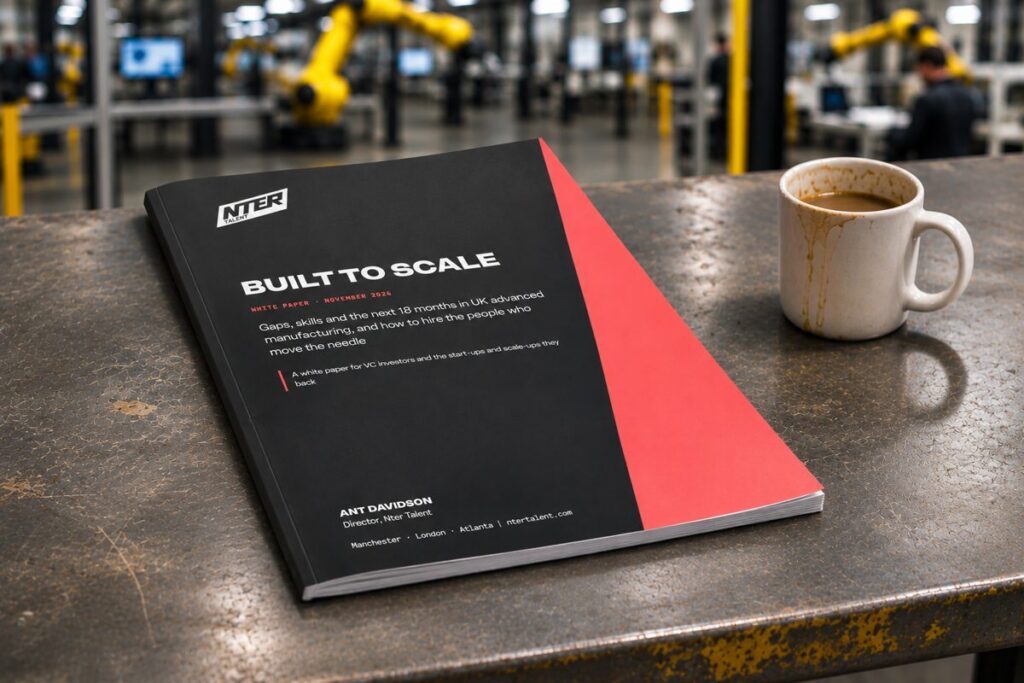
However, according to Nter Talent’s latest white paper, Built to Scale: UK Advanced Manufacturing, access to specialist talent could determine which businesses successfully capitalise on this growth.
Investment is accelerating across UK advanced manufacturing
The outlook for UK advanced manufacturing is increasingly promising.
According to research highlighted in our report, advanced manufacturing generated approximately £80.6 billion in gross value added (GVA) in 2024, representing around 6% of the UK’s total.
Meanwhile, equity investment in advanced manufacturing grew by 49% in 2025, the fastest growth of any of the eight sectors prioritised by the UK Government’s Industrial Strategy.
The Government has also committed up to £4.3 billion in sector funding over five years, with additional investment supporting automation, artificial intelligence, defence manufacturing and battery production.
For businesses operating across these industries, the opportunities are substantial.
However, investment alone cannot guarantee successful expansion. Businesses must also develop the operational capabilities, infrastructure and workforce required to turn innovation into commercially viable production.
The manufacturing skills shortage is becoming a critical barrier to growth
Despite a cooling wider recruitment market, specialist manufacturing talent remains exceptionally difficult to secure.
Our white paper identifies several figures that demonstrate the scale of the challenge:
- 148,000 workers will be needed across advanced manufacturing’s priority occupations by 2035.
- 76% of engineering employers struggle to recruit for certain skills.
- 57% of manufacturers identify a shortage of technically skilled candidates as their biggest recruitment barrier.
- 84% of additional advanced manufacturing jobs are expected to require Level 4 qualifications or above.
Importantly, the demand isn’t driven entirely by expansion.
Of the 148,000 workers required by 2035, approximately 101,000 will be needed to replace people leaving existing occupations, while 47,000 represent additional jobs created through growth.
This creates significant competition for experienced professionals, particularly those with specialist engineering, manufacturing operations and technical leadership experience.
Businesses are also competing against other high-growth sectors, including defence, clean energy and digital technology, which frequently require similar skills.
Which manufacturing roles are hardest to recruit?
As manufacturers transition from product development to commercial production, their recruitment requirements become increasingly complex.
Our research identifies several particularly challenging areas.
Automation and controls engineering
The growing adoption of robotics, automated production systems and industrial AI is increasing demand for professionals capable of designing, integrating and maintaining sophisticated manufacturing technologies.
Experienced automation and controls engineers are already highly sought after across automotive, FMCG, pharmaceuticals and industrial engineering.
Manufacturing and process engineering
Scaling production requires engineers who understand process optimisation, production efficiency, manufacturing systems and continuous improvement.
These skills are particularly valuable for businesses moving from prototype development to repeatable, high-volume production.
Supply chain and procurement
Establishing a reliable supply chain is fundamental to successful manufacturing expansion.
From supplier qualification and procurement strategy to managing long-lead components and reducing single-supplier dependencies, experienced supply chain professionals can make a significant difference to operational resilience.
For businesses developing new products, these capabilities should be established early rather than introduced once production challenges emerge.
Discover how Nter Talent supports businesses through our specialist supply chain and procurement recruitment services.
Operations and manufacturing leadership
Perhaps the greatest challenge is finding experienced leaders who have successfully taken a manufacturing operation from pilot production to commercial scale.
These individuals combine technical understanding with commercial awareness, workforce planning, operational leadership and the ability to establish systems from the ground up.
Their experience can be particularly valuable to venture-backed manufacturers navigating rapid growth.
Why hiring strategies must evolve alongside manufacturing businesses
One of the central findings of Built to Scale is that manufacturers frequently leave critical recruitment decisions too late.
For example, a business might invest in production equipment, secure customer commitments and establish a manufacturing facility before recruiting its first senior operations leader.
By that point, important decisions about production layouts, supplier relationships, quality processes and workforce requirements may already have been made.
Recruiting experienced operational leadership earlier allows businesses to make more informed decisions and potentially avoid costly delays.
Equally, employers must look beyond traditional sector experience.
Professionals working in automotive, aerospace, FMCG, food manufacturing and pharmaceuticals often possess highly transferable skills that can support emerging manufacturing businesses.
For example, candidates from high-volume food production environments may bring valuable expertise in operational efficiency, production planning, equipment performance and continuous improvement.
Nter Talent helps employers identify these transferable capabilities through our specialist logistics recruitment services and wider recruitment expertise across manufacturing and supply chain operations.
What will the next 18 months mean for manufacturing recruitment?
Looking towards 2027 and mid-2028, several developments are expected to intensify competition for specialist manufacturing talent.
Increasing defence expenditure is likely to generate additional demand for engineers, quality professionals and technical specialists.
Investment in semiconductor manufacturing and AI hardware will create further opportunities for experienced engineering and production professionals.
Meanwhile, the expansion of battery manufacturing and electric vehicle supply chains will place additional pressure on regional talent markets, particularly across the Midlands and South West.
For growing manufacturers, these developments reinforce the importance of proactive workforce planning.
Rather than waiting until a vacancy becomes urgent, businesses should identify the skills required to achieve their next commercial milestones and begin engaging with relevant talent well in advance.
Building a recruitment strategy that supports sustainable growth
Successful manufacturing recruitment requires more than simply advertising vacancies.
Employers must understand where specialist talent exists, what motivates experienced professionals and how to position their organisation competitively.
For start-ups and scale-ups, this can mean emphasising opportunities that larger organisations may struggle to offer, including genuine ownership, career progression, equity participation and the chance to shape a growing business.
A focused recruitment process is equally important.
Clear expectations, practical technical assessments and timely decision-making can help employers secure experienced candidates who may already be considering several opportunities.
Perhaps most importantly, recruitment planning should be directly aligned with operational and commercial objectives.
Whether a business is establishing its first production facility, expanding manufacturing capacity or entering new markets, the right people must be in place to support each stage of development.
Download our latest UK advanced manufacturing white paper
The UK advanced manufacturing sector has enormous potential, but turning that potential into sustainable growth will depend on businesses securing the specialist expertise needed to deliver.
Our latest white paper, Built to Scale: UK Advanced Manufacturing, explores the challenges and opportunities facing manufacturers, investors and growing businesses over the next 12 to 18 months.
Inside, we examine:
- The current UK advanced manufacturing landscape and investment outlook
- Emerging market opportunities across high-growth industries
- The specialist skills shortages affecting manufacturing recruitment
- The roles most difficult to recruit and where to find relevant talent
- Common recruitment mistakes when scaling from pilot to production
- A practical 90-day hiring playbook for start-ups and scale-ups
Download the full white paper to understand the recruitment challenges ahead and how to build a workforce capable of supporting your next stage of growth.
Specialist recruitment support from Nter Talent
At Nter Talent, we support organisations across the UK, US and Europe with specialist recruitment spanning supply chain, procurement, logistics, FMCG, food manufacturing and critical infrastructure.
From individual specialist appointments to multi-hire recruitment programmes, we work as an extension of our clients’ teams, helping them identify, attract and secure the talent required to achieve their objectives.
Planning your next stage of growth? Get in touch with Nter Talent to discuss your recruitment requirements.